Stratum
Working toward a reusable vertical-takeoff-and-landing demonstrator.
Working at the scale of millimeters and microns, where manufacturability guides every decision.
Build an engine. Learn the whole system.
Stratum is my independent reusable rocket project. The long-term objective is a demonstrator that can take off vertically and land again. The immediate engineering work is at the engine and component level.
A modified swirler built around straight shims.
At 45 mm outer diameter, the chamber's scale shapes the injector design. A traditional swirl injector would require features too small for me to machine. I kept my shim-based approach and moved six straight, flow-metering shims from the injector face onto the chamber walls. The rounded hexagonal profile gives me six straight sections for the shims, while its corners support CNC machining.
Inspired by a swirl injector, I use the shims to introduce propellants tangentially along the walls, aiming to create swirl and support atomization. I accepted less-smooth tangential injection and less straightforward engine throttling as tradeoffs.
My work combines CAD design exploration with Python analysis to examine the assumptions behind a candidate design.
My October 8 CAD review of Foundation 1, Iteration 37 identified tolerance and chamber-geometry problems that required a redesign. I'm now developing the new chamber and injector geometry.
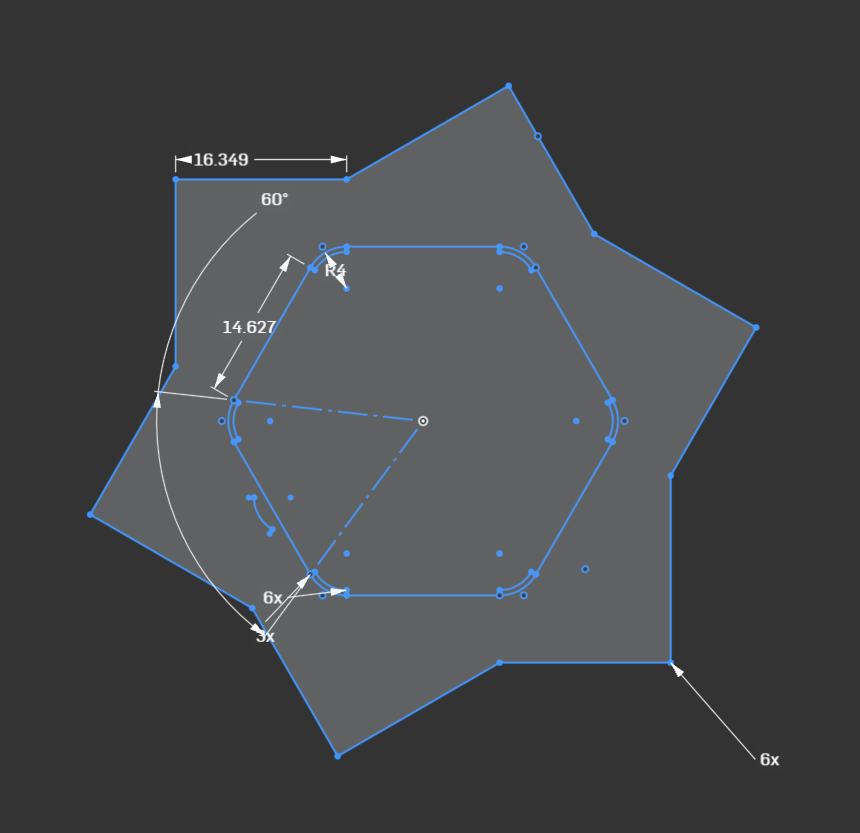
My top-view engineering drawing of the rounded-hex chamber, with six straight walls for the shim-based injector concept.
View full-resolution drawing ↗Geometry has to work beyond the sketch.
A chamber shape alone does not establish how an injector will perform. Passage direction, plate alignment, separate fluid paths, seals and the interface to an existing machined nozzle all constrain the design.
In my October 8 review of the earlier design, I assessed injector dimensions and tolerances, the machined throat and combustion chamber, and overall assembly risk. I flagged the pintle-to-plenum inner-wall tolerance and chamber length as major problems.
Keep the shims; change the geometry.
I rated the earlier injector's overall tolerance risk as high and the machined throat and combustion chamber risk as very high. My conclusion was that a redesign was necessary.
My next step is to resolve the passage paths and mating interfaces, then evaluate the design through further analysis and testing.
My October 8 CAD review.
I documented the review of Foundation 1, Iteration 37 across four areas: key injector dimensions, injector tolerances, the machined throat and chamber, and assembly risk.
- Injector dimensions
- I rated the overall risk as low.
- Injector tolerances
- I rated the overall risk as high, including a critical pintle-to-plenum inner-wall tolerance.
- Throat & chamber
- I rated the overall risk as very high and flagged the chamber length for redesign.
- My conclusion
- A redesign was necessary.
My review of the earlier design, with the original redactions preserved.
Component development, with open questions.
My CAD review: . New chamber drawing: October 2026.
- Design & analysis
- I've documented my review of the earlier design and am developing the new chamber and injector geometry.
- Fabrication
- My review covers existing machined parts. I'm still developing the revised assembly.
- Testing
- I'm presenting design and review evidence here. Engine firing and flight testing remain later development stages.
- Next engineering step
- I need to resolve the new passage paths and mating interfaces, then check the design against measurements and further testing.